

Sizing the Trade Before You Take It
No indicator is right for everyone — it depends on what you trade and what you already know how to read. But the ones worth keeping share a short list of properties, and the ones you uninstall tend to fail in the same four places. Here’s the checklist, category by category.

By SWEEPLOGIC
- June 27, 2026
- 9 Min Read
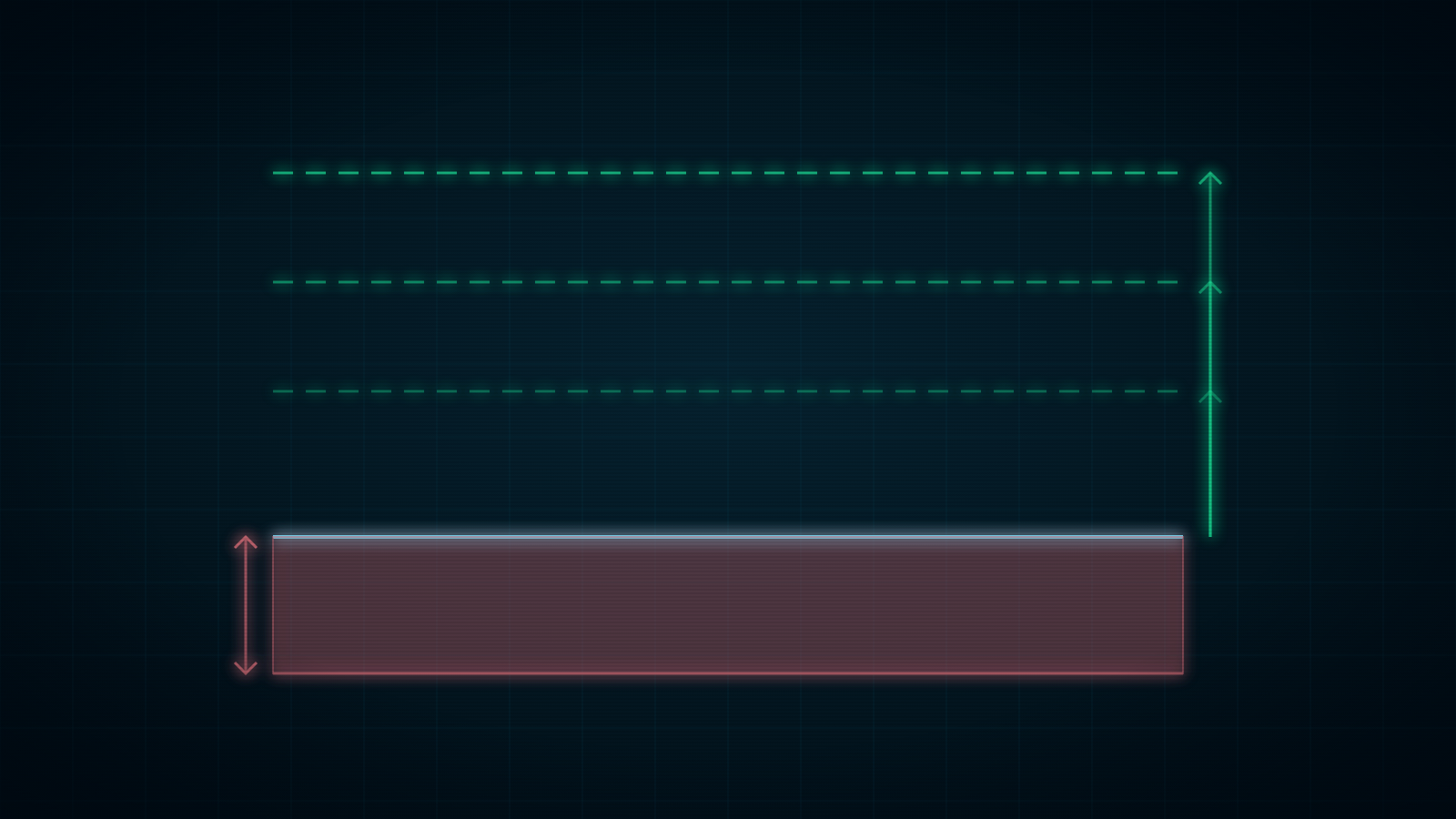
Most traders just pick a size, place a stop where it feels safe, hope the target is far enough away. Wrong.
The correct order runs the other way: the stop is determined by structure, the size is determined by the stop and your risk cap, and the targets are determined by liquidity. Every number is derived. None of them is chosen.
This is the walkthrough.
The stop comes from structure
The stop goes where the trade idea is wrong. Not where you can afford it to be, not a fixed number of points — where the premise fails.
- For a bullish entry off an order block: below the block’s low, plus a small buffer for spread and noise.
- For an entry off a fair value gap: below the gap’s far edge, since a close through it invalidates the zone.
- For a sweep-and-reversal entry: below the sweep’s extreme, since a return through it means the reversal read failed.
If that distance is uncomfortably large, the answer is not to move the stop closer. The answer is a smaller position, or no position. Moving the stop inside the structure that defines the idea means you’ll be stopped out by the noise the idea was built to survive.
Stop distance is an input, not a variable. It’s determined by the chart before you’ve decided anything about size. If you find yourself adjusting the stop to make the size work, you’ve inverted the process.
Size falls out of the risk cap
Two numbers determine position size:
- Risk per trade — a fixed dollar amount, or a percentage of account equity. Decide this once, in advance, away from the market.
- Risk per contract — stop distance in points, times the instrument’s point value.
Divide the first by the second and round down. That’s your size.
On NQ at $20 per point: a 30-point stop is $600 of risk per contract. A $300 risk cap means the position size is zero. That’s not a bug — it’s the arithmetic telling you the trade doesn’t fit your account at that stop distance. MNQ at $2 per point is the same trade at a tenth the size, and that’s frequently the right answer.
Two additions worth building in:
- Commission and fees. Round-turn costs are part of the risk. A trade with a small stop can have costs that are a meaningful fraction of the risk, which changes the real risk-to-reward.
- A hard cap. A ceiling on maximum risk per trade that blocks the trade outright, rather than silently sizing down. Most of the time auto-capping to a smaller size is what you want. When one contract already exceeds the cap, you want the plan to refuse, not to round to one anyway.
Targets come from liquidity
Targets placed at fixed R multiples are arbitrary — the market doesn’t know about your 2R.
Targets placed at liquidity have a reason: a pool of resting orders that price has a mechanical incentive to reach.
The reconciliation between the two: use R as the anchor and liquidity as the placement. Start with an R level — 2R, 3.5R, 5R — then look for real structure near that anchor and snap the target to it. A prior swing high near your 2R anchor is a better target than 2R exactly. If nothing is near the anchor, the plain R level is a reasonable fallback.
This keeps targets both structurally justified and consistently scaled to risk, which is what makes multi-target partial-exit plans comparable across trades. Image-plan with three targets, each labeled with its R value, snapped to nearby levels.
The R:R you actually get
With multiple targets and partial exits, headline R:R is misleading. If you scale out 50% at 2R, 25% at 3.5R, and 25% at 5R, your realized R on a full run is not 5.
It’s the weighted average: (0.50 × 2) + (0.25 × 3.5) + (0.25 × 5) = 3.125R.
Two things follow.
- Compare blended R across setups, not headline R. A single-target 3R trade and the scaled plan above are near-equivalent on a full run — but the scaled plan banks something at 2R, which is a different risk profile even at similar expectancy.
- Know your required accuracy. For any R, the breakeven rate is 1 ÷ (1 + R). At 3R that’s 25%. At 2R it’s 33%. At 1R it’s 50%.
That last figure is the useful one, because it reframes the question. Instead of “will this work,” it becomes “do I believe this setup resolves in my favor more than 25% of the time.” That’s an answerable question, and it’s a much better filter than conviction.
Required accuracy is 1 ÷ (1 + R). It turns “do I like this trade” into a question you can actually answer.
Scaling out, honestly
Partial exits are a psychological tool as much as a mathematical one, and it’s worth being clear about the tradeoff.
- What scaling out costs you. On trades that run to the final target, you’ve reduced the position before the best part. Pure expectancy usually favors a single well-placed target.
- What scaling out buys you. Banking a partial at the first target reduces the chance of watching a winner round-trip to breakeven, which is the specific experience that causes people to abandon a plan mid-trade. A slightly worse expectancy you actually execute beats a better one you don’t.
If you scale out, decide the percentages before entry and don’t change them mid-trade. The mid-trade adjustment is where the plan quietly stops existing.
Before you click
The pre-entry checklist, in order:
- Stop is at structural invalidation, not at a comfortable distance.
- Size computed from risk cap ÷ risk per contract, rounded down.
- Position risk within your per-trade cap — verified, not assumed.
- Targets anchored to R and snapped to real liquidity.
- Blended R:R computed, and required accuracy noted.
- Partial percentages set in advance.
Six checks. They take under a minute once they’re habitual, and they’re all done before any money is committed — which is the only time you’ll evaluate them clearly.
How SweepLogic Can Help
SweepLogic Chart Trader is a NinjaTrader drawing tool that builds this plan on the chart in two clicks. Drag entry and stop; targets, size, blended R:R, and required win percentage compute live.
Sizing models include fixed dollar, percent of account, fixed contracts, contracts per equity, and dollar per point, all capped by a maximum-risk-per-trade gate that hard-refuses when a single contract already exceeds the cap rather than silently rounding. Commission is included in the risk math. Each target carries its own ratio and partial percentage, and the on-card lot stepper lets you override size manually within the cap.
The plan is a drawing object, so it lives on the chart and can be dragged, adjusted, and re-evaluated before anything is committed. Pairs with Key Levels and Order Blocks for the structural references that determine where the stop and targets belong.
Visit our free Discord and give us a follow on our Instagram to stay in touch on latest releases and updates.
Educational content only. Nothing here is financial advice or a recommendation to trade. Futures trading involves substantial risk of loss and is not suitable for every investor. Past market behavior does not indicate future results. SweepLogic products are analytical tools; they do not predict market direction and do not produce trading results on their own.
- FROM THE SUITE